 omnigate
Text gateway
Chat, messages, embeddings and responses endpoints, streaming and not. An OpenAI client can use an Anthropic-style upstream and the reverse, with tools, images and structured output translated.
API referencePre-release 0.1.0-rc.1 · source-available
omnigate puts one port in front of OpenAI- and Anthropic-style text APIs and seven kinds of media provider, with gateway keys, budgets, failover and a usage ledger. It is two small processes and files on disk: no database, no queue, no cloud account.
Chat, messages, embeddings and responses endpoints, streaming and not. An OpenAI client can use an Anthropic-style upstream and the reverse, with tools, images and structured output translated.
API referenceThe next target is tried on timeouts, 429 and 5xx before any byte reaches the client. Each key has a model list, a rate limit, a concurrency limit and a budget.
ConfigurationImages, speech, sound, music and video as jobs with signed, retried webhooks. Outputs are copied to your own bucket or disk, and a job can fail over between providers.
ProvidersUsage is read from the provider's own counts, spooled to disk and deduplicated by request id. A call made while the control plane was down is billed once.
ArchitectureRedact personal data and secrets before a provider sees them, keep no request content, encrypt job outputs, and unlink usage from the key. Per key or per request.
Privacy modeThe data plane uses the Zig standard library only; the control plane has two direct Hex packages. The security model, known limits and past advisories are written down.
Security policyOptional · NEAR AI Cloud
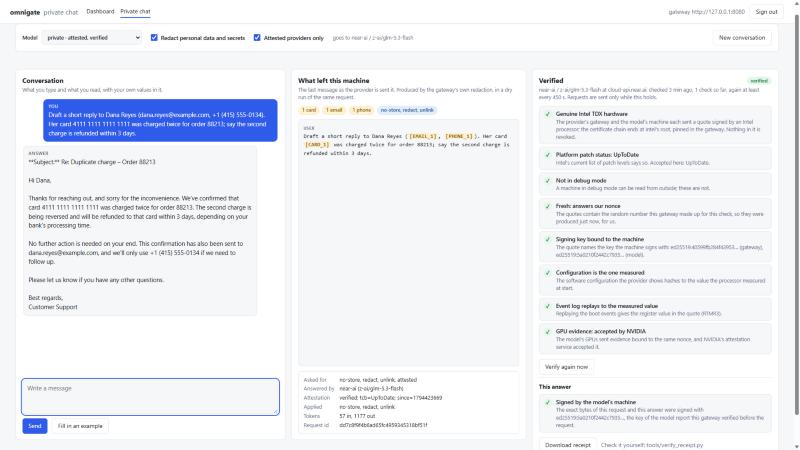
For models that run in a trusted execution environment, the gateway checks the provider's evidence itself instead of taking its word:
attested gets 503 instead of an answer when verification fails. It cannot reach an unverified model.Without an attestation block in the config none of this is active, and omnigate is a plain model gateway.
Optional · NEAR Intents
A prepaid key holds credit: one credit is one dollar when it is added, and a request burns what the provider charged times a multiplier you set. When the credit runs out, the holder of the key, or an agent using it, can buy more without anyone in between:
# a key that is out of credit can still do this
curl $GATEWAY/v1/payments \
  -H "Authorization: Bearer $KEY" \
  -d '{"amount_usd": 5,
       "asset": "nep141:wrap.near",
       "refund_to": "payer.near"}'

# → a deposit address, the amount to send, a deadline
# then: awaiting_deposit → processing → settledOne machine, localhost, against a mock provider written in Python. This shows the gateway is stable and not a bottleneck in front of a mock; it is not a comparison with any other gateway. How these were taken
omnigate is a pre-release. The text gateway and seven of the eight media adapters have been checked by hand against the real provider APIs, and every push runs the unit, end-to-end, SDK, container and hostile-input suites. It has never served production traffic.
Other gateways are ahead in places, and the README says where:
With Zig 0.17, Erlang/OTP 29 with Elixir 1.20 and Python 3.9 or newer:
git clone https://github.com/Legatia/omnigate
cd omnigate/dataplane && zig build
cd .. && python tools/e2e.py
The last command starts mock providers, both processes and a few hundred checks; no API key is needed. On a server, a Compose file with a TLS proxy is included.
omnigate is source-available under the PolyForm Noncommercial License 1.0.0: free for personal projects, learning, research and noncommercial organisations. Use in or for a business needs a commercial license; write to hello@legatia.solutions.